You sell somebody else's product and take a cut. You never build it, deliver it, support it, or refund it. What you own is a list of people who take your recommendations, and the recurring commissions attached to it.
That is also what it costs you. You control none of the delivery, none of the support, and none of the terms, and the playbook says so in section 3 rather than hiding it. In exchange you carry no product, no team, and no refund queue.
It is the slowest route on the Redundant shelf and the one with the longest tail. Expect months before the money is worth mentioning.
The tell that routes you. Do you have customers, an audience, or capital? Customers with no leverage go to Productize. No customers and no audience go to Agency. An audience, or the willingness to build one, is this one. Capital and a salary go to Acquire.
Two facts that sound like they cannot both be true.
US affiliate spend is $13.81 billion in 2026, up 11.3% on 2025, and around 84% of ecommerce brands run a program. The money is there and there is more of it every year.
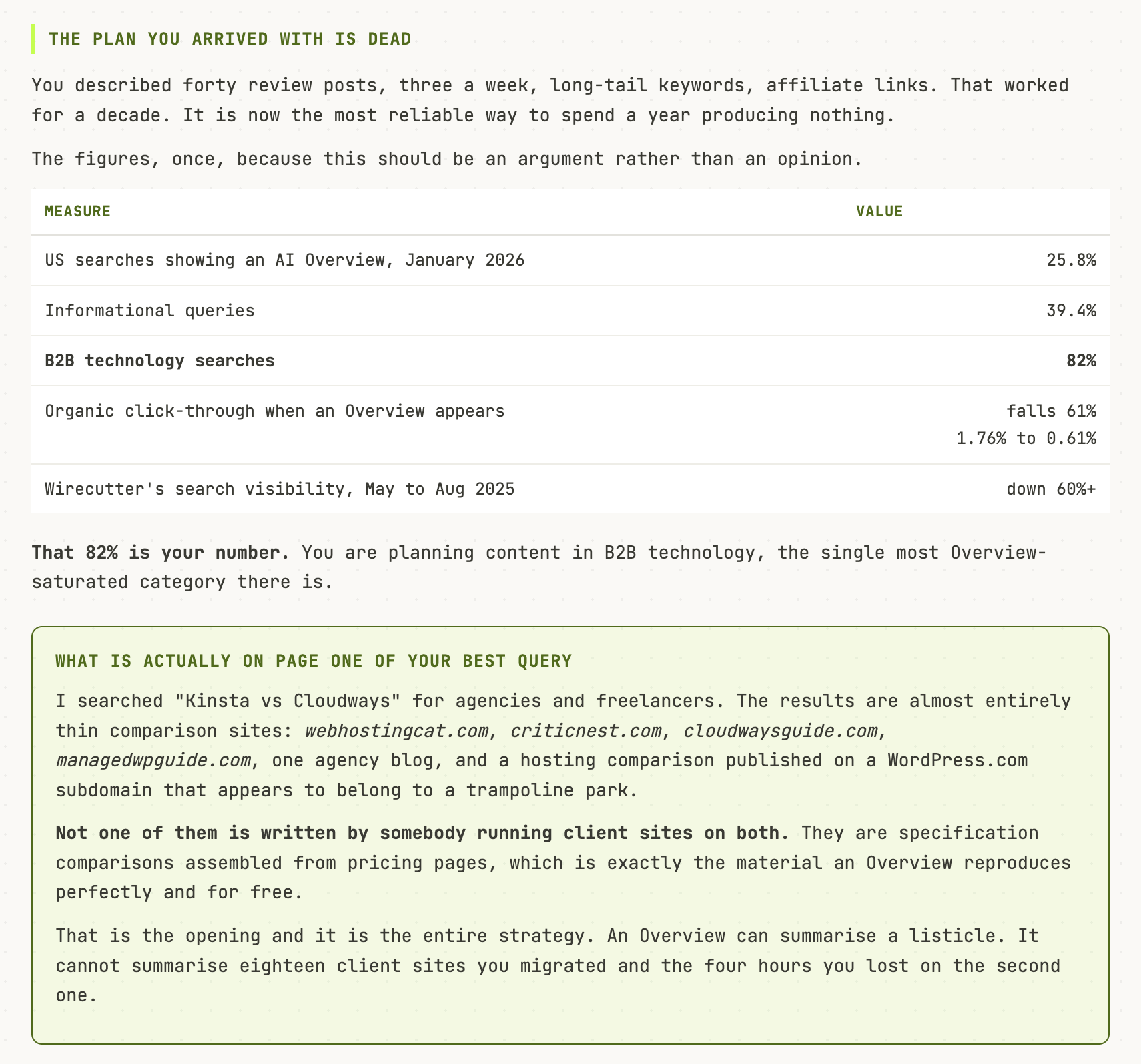
And Google AI Overviews now appear in 25.8% of US searches, 39.4% of informational queries, and 82% of B2B technology searches. Organic click-through falls 61% when an Overview appears, from 1.76% to 0.61%. Wirecutter lost over 60% of its search visibility between May and August 2025. Amazon Associates cut commission rates by up to 50% through early 2026, dropped premium categories from up to 10% to 4 and 5%, removed milestone bonuses, ended halo-sale commissions in the April 2026 operating agreement, and announced none of it.
The money did not leave. The mechanism most people used to earn it did.
The click got cheap and the trust got expensive.
An AI Overview can summarise a review. It cannot be someone who used the software for two years and will tell you which part is annoying.
In 2017 I sold funnelengine.com for six figures. It was a software review site making $3,000 to $5,000 a month promoting ClickFunnels, SamCart and Drip.
Inside the ClickFunnels affiliate account: the commissions as they actually arrived, and why the account itself was the thing being priced. Watch on YouTube ↗
The lead magnet was free funnel templates for ClickFunnels users. It collected about 15,000 emails, and that list drove nearly all the revenue, which I did not understand at the time. I kept pruning it under 5,000 subscribers to avoid a bigger plan on Drip.
The entire valuation was the two affiliate accounts. Not the rankings. Not the content. The recurring commissions attached to customers I had already introduced.
In 2020 I ran a website-investing publication: a $50/month paid Substack with over a hundred subscribers, plus a free newsletter monetised with sponsorships and affiliate deals. That also sold for six figures, to Travis Jamison. Both exits are documented in the beehiiv creator spotlight.
I have since sold a second affiliate account, the beehiiv one, as a named part of the LetterOperators sale. Same asset class, priced properly the second time.
Since then: a top-ten SamCart affiliate and one of ClickFunnels' biggest. I was also the top affiliate for Odys Global and for Content at Scale for a period each, which is my own account of it rather than a published leaderboard. And I am Work Hero's number one affiliate, confirmed by their founder.
That last section of the document is the part nobody tells you: recurring affiliate accounts are a balance-sheet asset, not income, and they sell. I sold the same thing twice, badly the first time and properly the second.
Every report below is real output, run in dependency order against one person: a freelance web developer with no list, ten hours a week and no ad budget. Same persona throughout, so they read as one continuous story rather than ten disconnected demos. Every commission figure is either traced to a programme's own terms or labelled an assumption.
1 · Promote Angle Finder find my promote angle
run this first: before you write anything or join anything
Decides who you promote to and what category of offer is worth promoting to them, by testing what you already know against three filters: budget, endurance, and commissionability. The third one is the one nobody checks until month nine: can you actually earn a commission on what this audience buys? An audience can trust you completely and still be impossible to monetise this way. It is a hard filter, never a tiebreak, and the worker is allowed to tell you the answer is no and name the two real options instead.
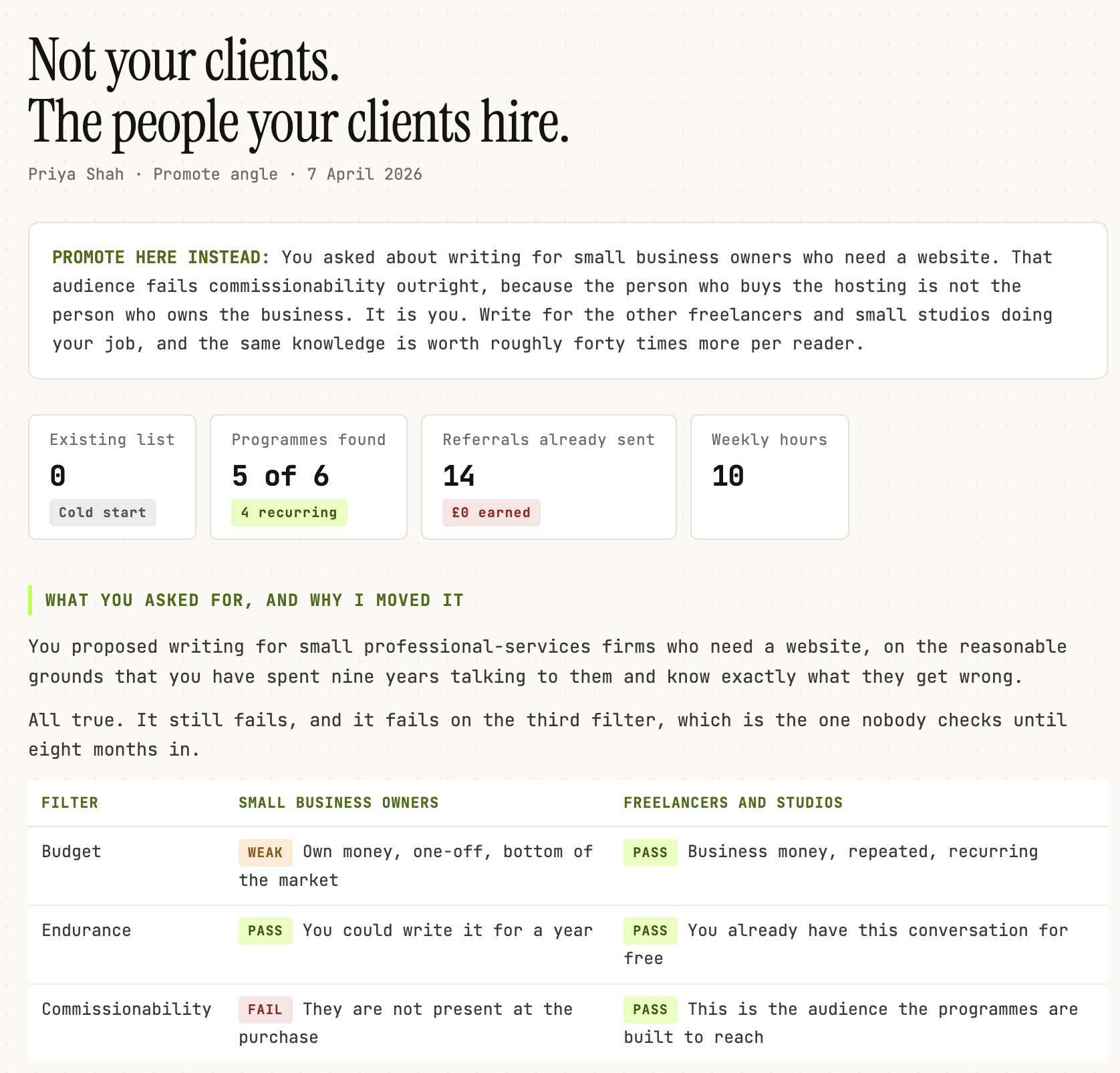
2 · Offer Portfolio Scout find offers to promote
Five to eight real programs ranked by what a referred customer is genuinely worth to you, not by headline rate. A 25% recurring commission on a $99 subscription is worth roughly a hundred times a 4% one-off on a $60 order, for the same work. A ranked shortlist with the money modelled, not a directory dump.
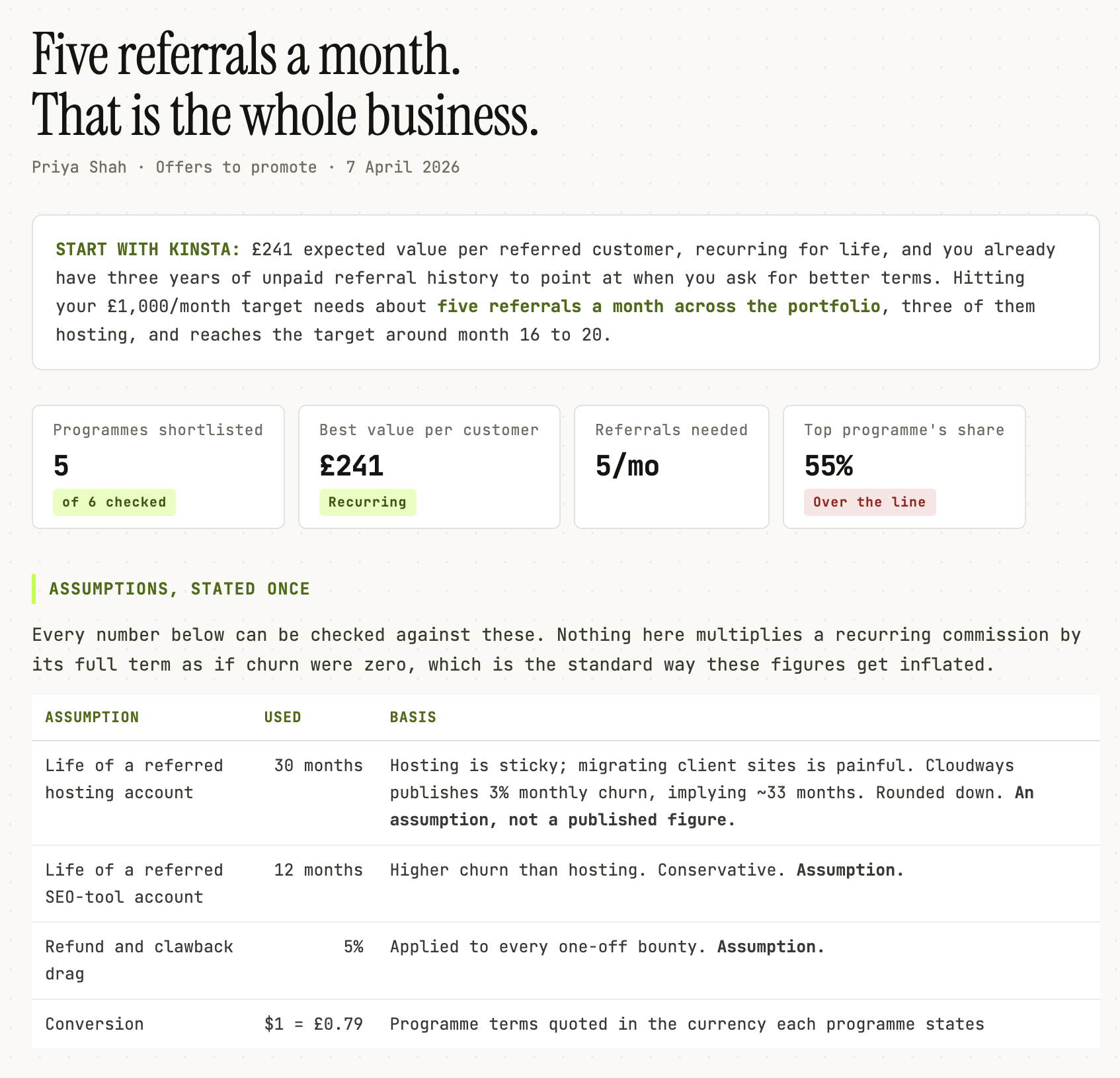
3 · Affiliate Program Grader grade this affiliate program · free, and also available on its own
run this before: you join a program or send anybody anywhere
Eight sections scored before you point an audience at somebody's checkout: attribution, cookie window, recurring treatment, refunds and clawbacks, payout mechanics, promotional restrictions, unilateral change rights, and leakage at checkout. Every section PASS, WARNING or FAIL with the clause quoted, then the questions to put to the program manager in writing.
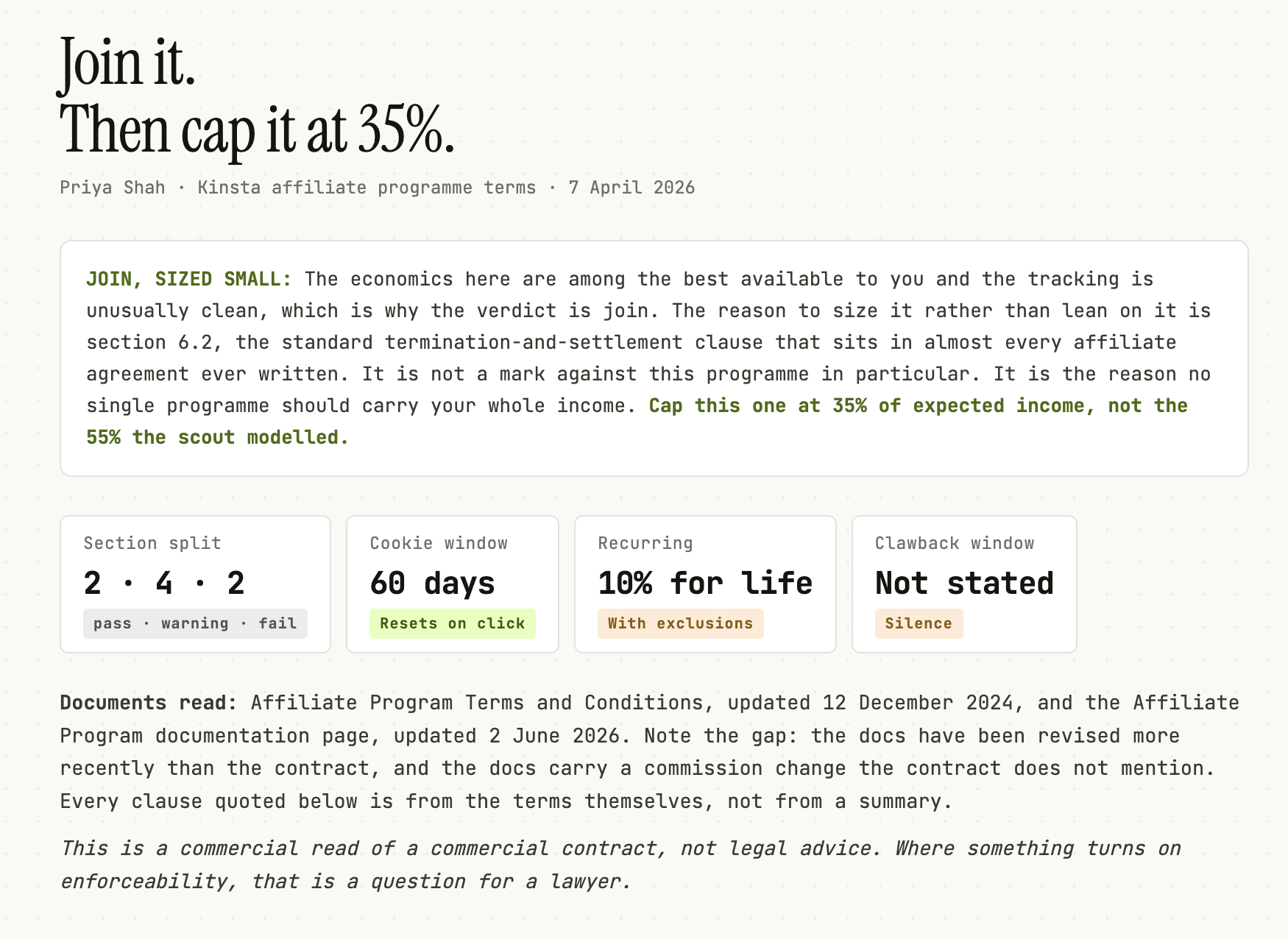
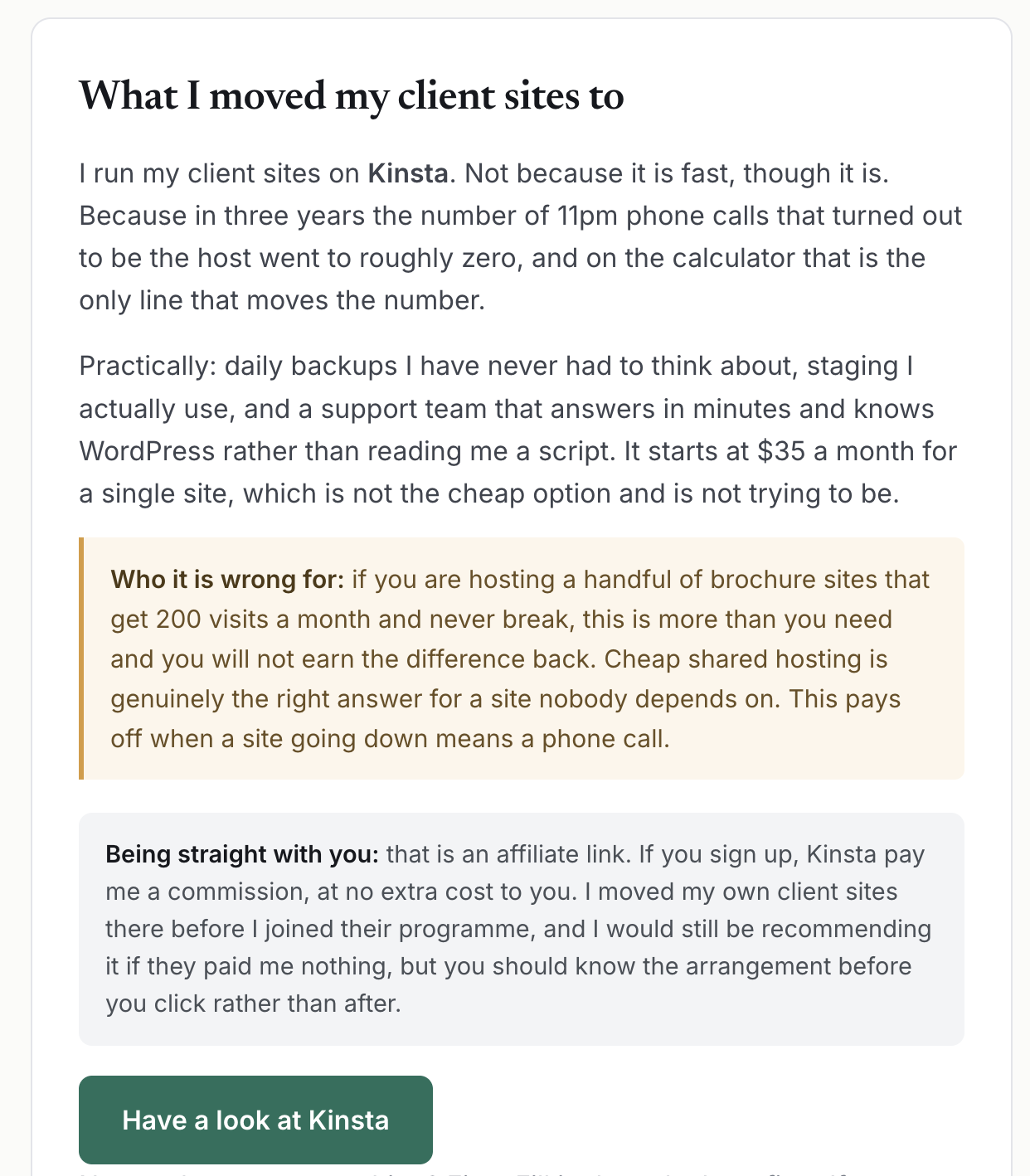
Run on Kinsta's real terms: two passes, four warnings, two fails, and the verdict is still join. What decides the sizing is section 6.2, the termination-and-settlement clause that sits in almost every affiliate agreement ever written. It is not a mark against that programme. It is the reason no single programme should carry your whole income, so the report caps this one at 35% rather than the 55% the scout had modelled. Read the full grade (PDF) ↗
This one is free, separately, and it is in your download anyway. Nobody should have to spend $299 to read a contract. Same file either way.
4 · Lead Magnet Builder build my lead magnet
Builds three pages, not two: the deliverable, the capture page, and the thank-you page carrying your first recommendation. Two rules on the magnet, both learned the hard way: build a tool rather than a guide, and make it useless to anyone outside your audience. My funnel templates only worked if you already had ClickFunnels, which is exactly why the addresses they collected were worth something.
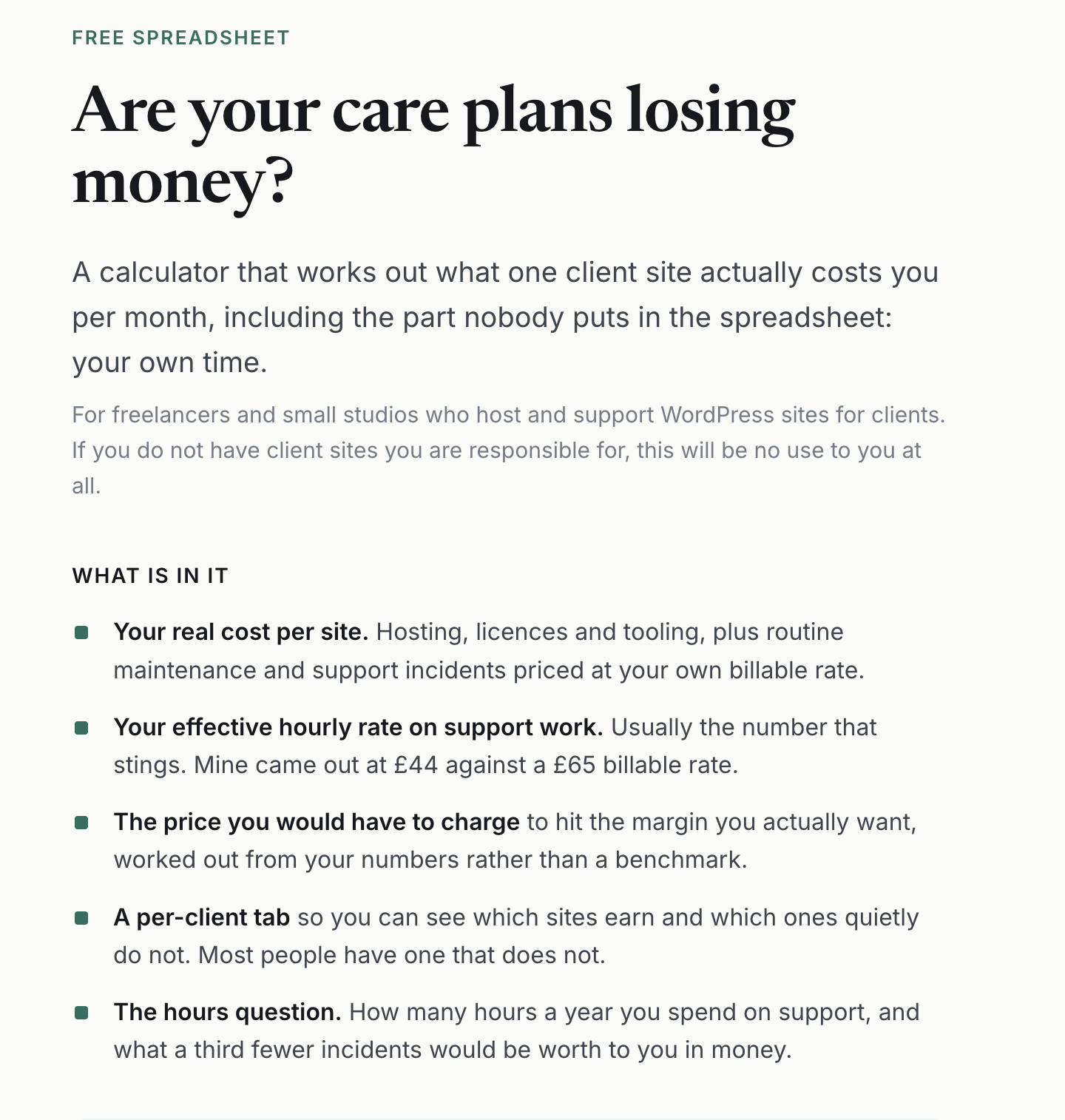
The capture page, then the thank-you page. The second one carries the first recommendation with the disclosure next to the link. It is the monetisation moment and it is the one everybody leaves blank.
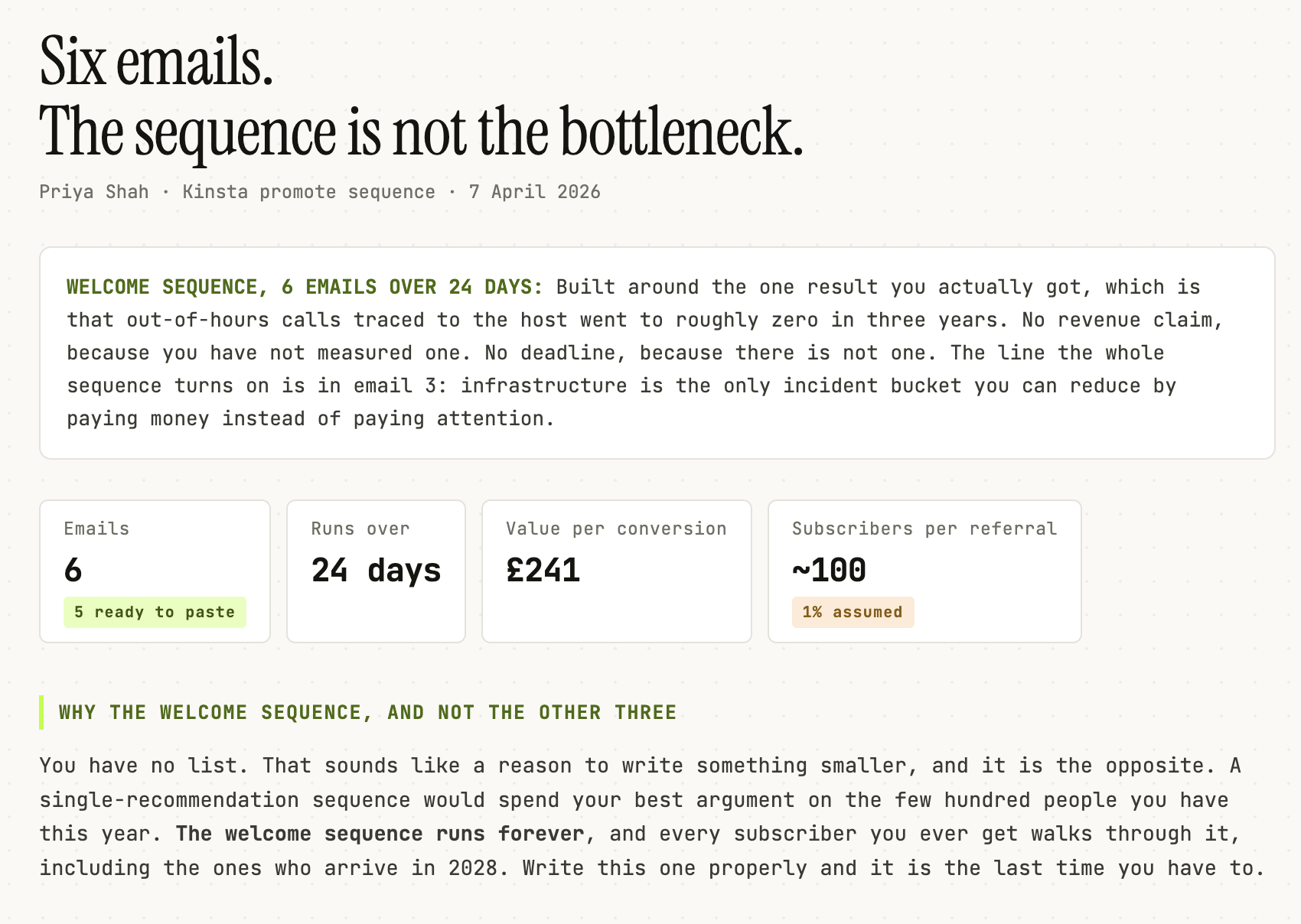
5 · Promote Sequence Writer write my promote sequence
Every email written in full, with timing, trigger and exit conditions, and the disclosure inside each email next to the link rather than in a footer. It will decline to produce a promotional email without one. Drafts only: it never sends, schedules, or connects to an email platform.
6 · Buying Intent Content plan my promote content
The small number of pieces a year that still convert after an AI Overview, with a full brief per piece, plus the non-search surfaces where your audience actually decides. Writes briefs and drafts. Publishes nothing.
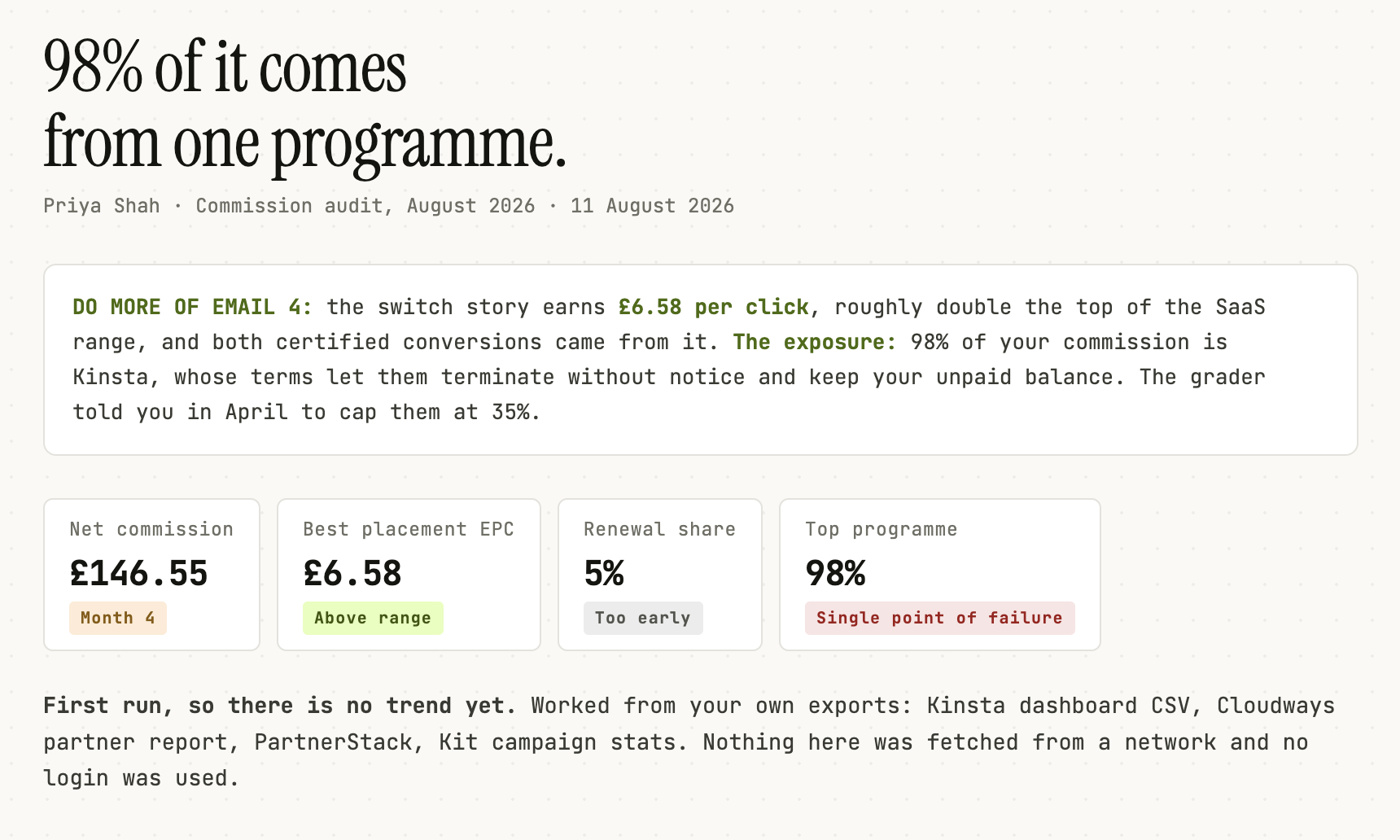
7 · Commission Audit audit my commissions
The monthly money read, from your own exported reports: what each placement earned per click and per subscriber, what the refunds and clawbacks took back, and how exposed you are to one program changing its terms. It never asks for a network login and never touches a dashboard. It runs before the paid worker, because it produces the number that one refuses to start without.
8 · Paid Acquisition run my paid acquisition
Gated, not permissive. It refuses to plan a campaign until you know your revenue per subscriber, which is why the commission audit runs first. Safety factor of at least two on a first campaign, because paid subscribers convert worse than organic, and a kill rule written as a number before anything runs. Paid traffic goes to your own opt-in, never to an affiliate link. It plans campaigns and never opens an ad account or spends a penny.
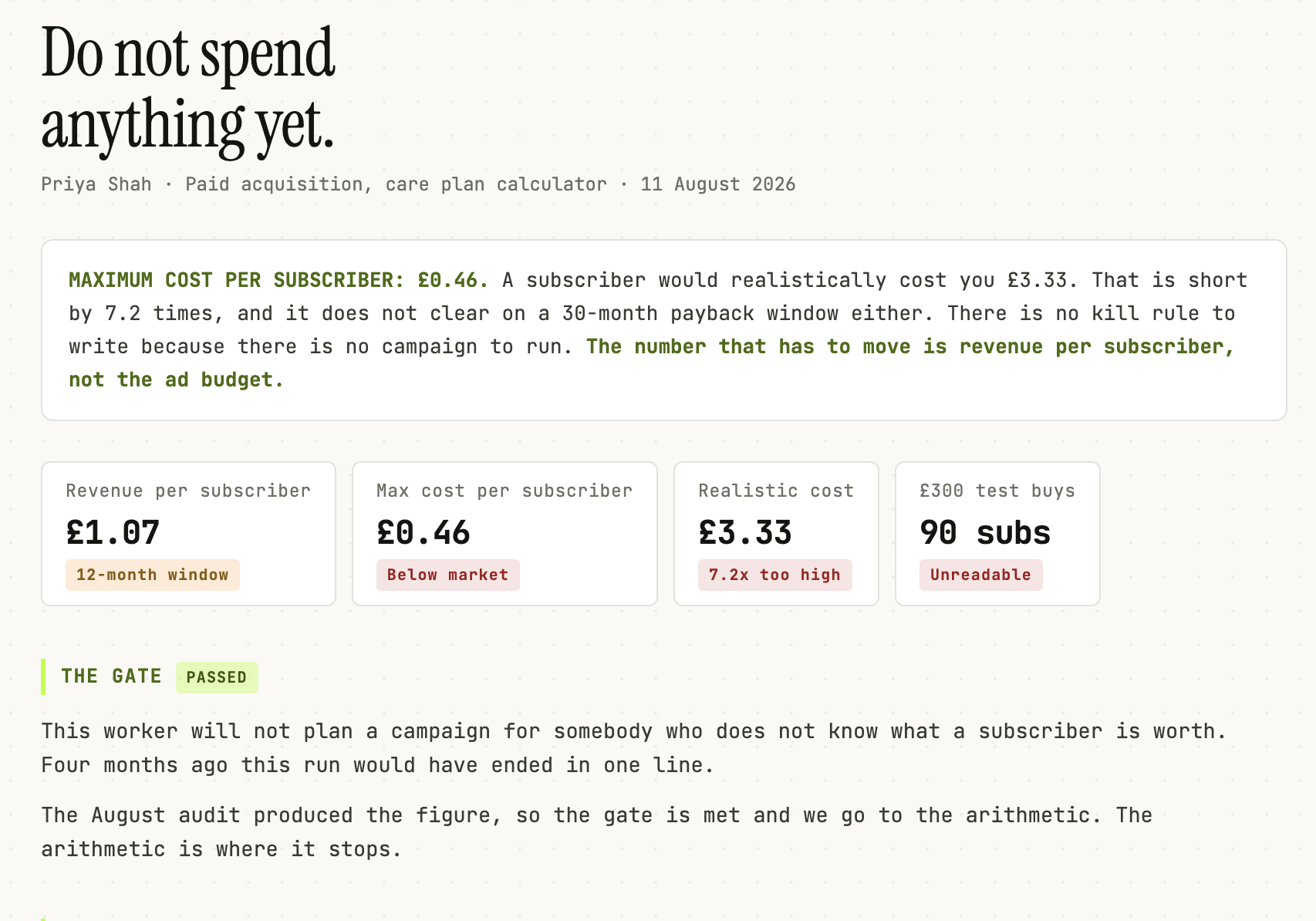
On this persona the verdict was DO NOT SPEND ANYTHING YET, and it showed the sum: the campaign fails by 7.2x. Read the full plan (PDF) ↗
9 · Partner Deal Negotiator negotiate my affiliate rate
The published rate is the rate for people the merchant has never heard of. Once you are sending real volume this builds the case and drafts the ask: a custom rate, a longer cookie, a bonus tier, a private landing page, or a direct rev-share negotiated with the founder. Probably the highest-return hour in the product. It drafts the email and sends nothing.
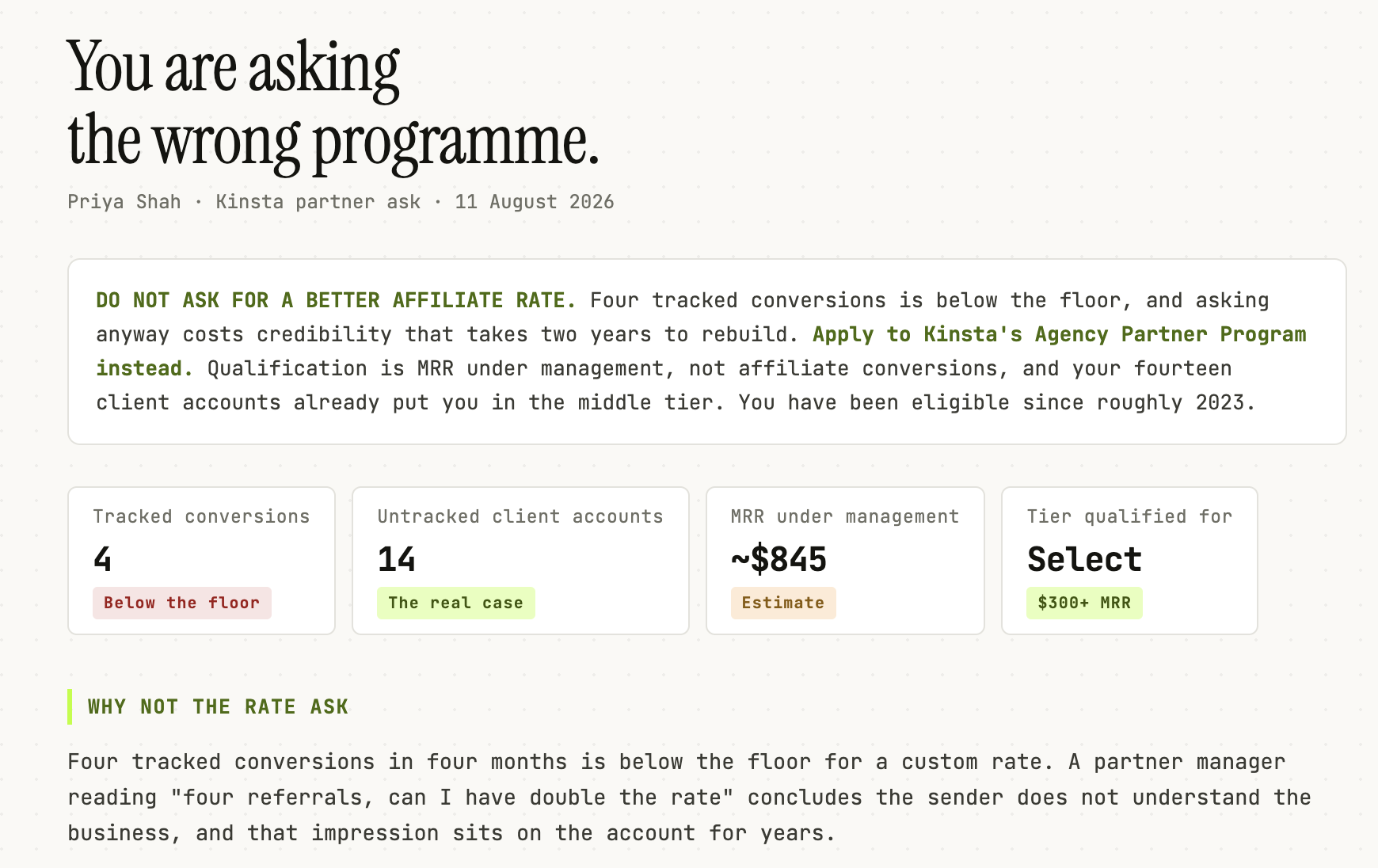
On this run it told the user not to ask yet, then found a tier they already qualified for and had not claimed. Read the full ask (PDF) ↗
10 · Promote Traction run my promote review
The honest progress read, judged on whether the right actions happened rather than on whether money arrived. It names the stall and makes the difference between "this is slow" and "this is wrong" explicit. It carries a log between runs and is allowed to conclude that the audience is wrong and the first worker should run again.
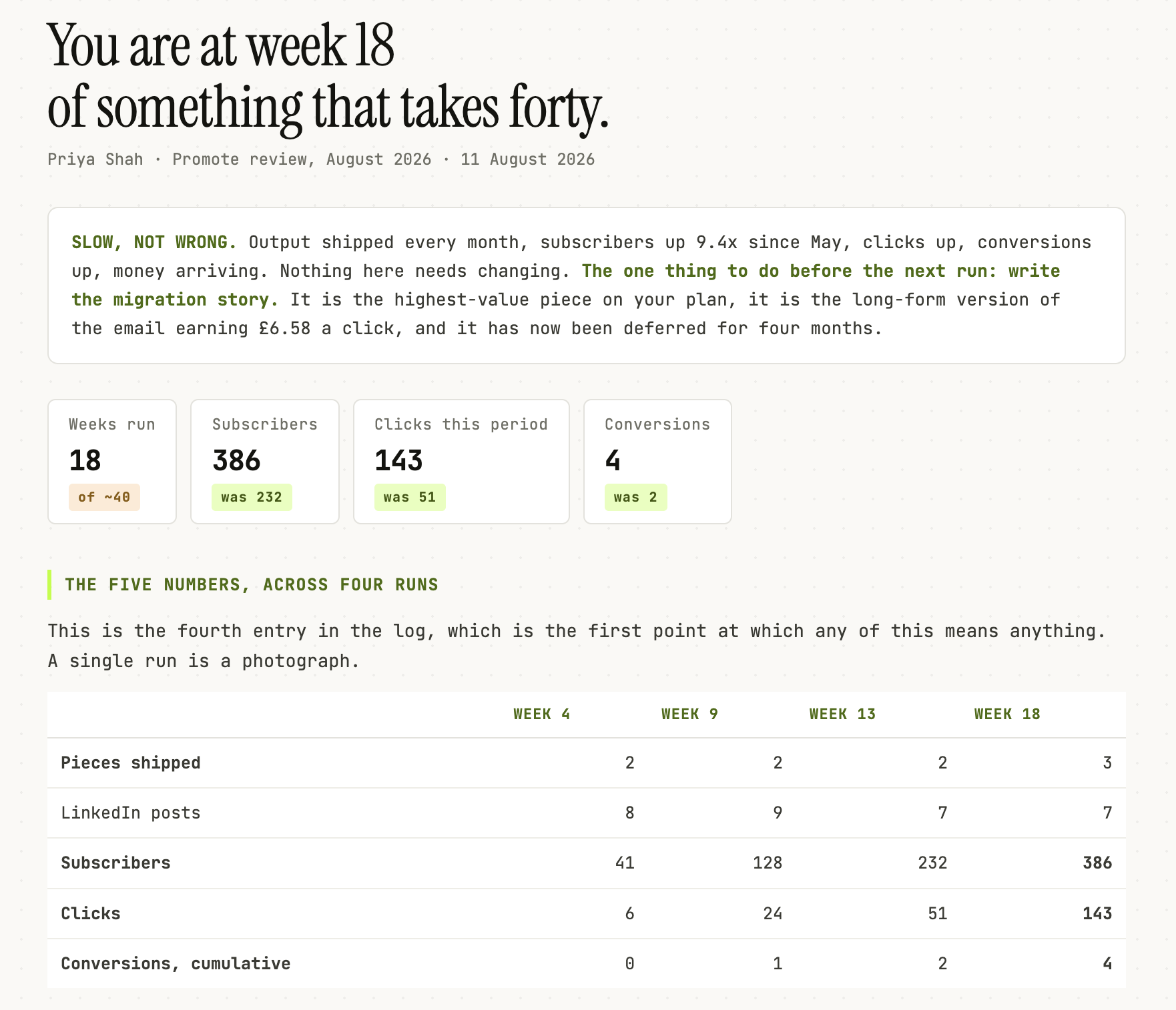
Four months in, on almost no revenue, the verdict was SLOW, NOT WRONG. Read the full review (PDF) ↗
- That your chosen audience buys things you cannot earn a commission on
- That the customers you would need to refer exceed what your audience could plausibly produce
- That the program you are excited about can cut your rate retroactively, and reserves the right in writing
- That one program is now more than 70% of your income, which is a single point of failure
- That the audience is wrong and the first worker should run again
All five are explicit findings inside the workers, because discovering them in month nine is the expensive version.
One distinction runs through the whole product, because "audience" was doing two jobs and hiding the important half.
Traffic is how strangers find you. Search, paid, communities, somebody else's newsletter. It is rented and substitutable, which is why the source genuinely matters less than people think, and why paid is a legitimate channel here.
The list is who agreed to hear from you again. That is the asset, and it is what actually pays.
Traffic fills the list. The list is the business. Which is why the structural rule is absolute and appears in the document, the paid worker and the content worker alike: traffic goes to your own opt-in first, never to an affiliate link.
Work Hero
I am Work Hero's number one affiliate, confirmed by their founder. They sell flat-fee WordPress support to agencies and site owners: send them the job, it comes back done.
It is right for you if you run WordPress and you are the one fixing it at eleven at night. It is wrong for you if you do not run WordPress, if your site is simple enough that nothing ever breaks, or if you actually enjoy that work.
That is an affiliate link. I get paid if you sign up, and I would send it either way. See Work Hero ↗
Now look at what that block just did: it named the problem, named who it is wrong for, put the money next to the link instead of at the bottom of the page, and invented no deadline. That is the method this playbook teaches, and you have just watched me use it on you.
Thirteen sections, written to be read in one sitting. The Click Got Cheap: the two facts and why both are true. What You Are Actually Selling. What It Costs To Not Own It, stated as a cost rather than hidden. The Arithmetic, which is the sum most people run in month eight instead of week one. Choosing The Audience. Choosing What To Promote. The List Is The Asset. Filling The List, including paid, honestly. The Sequence. Content After The Overview. Getting Off The Public Rate. What A Year Actually Looks Like, including the one I got wrong. And Selling The Account, which is the argument nobody else is making. Then the first ninety days.
- The commission economics sheet. Earnings per click by placement, what one referred customer is worth on a recurring program against a one-off, refund and clawback drag, revenue per subscriber, the customers-required arithmetic, and the concentration check.
- The 90-day tracker. One row per week, tracking actions rather than outcomes, with weeks-run surfaced because it is the number that recalibrates everyone.
A year of Pro membership. The Redundant community's locked Pro channel, included for 12 months: where the lead magnets get posted before they are built, the programs get compared, and the terms get read by somebody other than you. Normally $19/month, not billed to you for your first year.
- Promote Playbook plugin. Install once in Claude Cowork and all ten workers appear, with the docs and the toolkit alongside them.
- The Affiliate Program Grader. The same worker that is free on its own, included so there is nothing to go and fetch.
- The playbook document, thirteen sections.
- The two toolkit spreadsheets.
- START-HERE: fresh install to a tested audience and a verdict in one sitting, written for non-technical people.
- Your community invite: 12 months of Pro membership.
You need Claude Desktop with Cowork, a paid Claude subscription, and a working folder. No connectors required. Every worker is a plain-text instruction file you can read before you install it. Nothing sends: the sequence writer drafts emails and does not send them, the magnet builder writes pages and does not publish them, the negotiator drafts the partner email and contacts nobody, and the paid worker plans campaigns and never opens an ad account. No worker will ever ask for your affiliate network credentials.
The playbook names Flippa as its live worked example, and I earn a commission on Flippa listings promoted in the weekly Redundant email. Anywhere in this product where I have a commercial relationship with something named, it says so in the same breath.
Not financial or legal advice. Affiliate income depends on programs you do not control, and the playbook is explicit about what that costs you.
Get the playbook · $299