A free AI worker that grades any affiliate program on the eight things that decide whether you actually get paid. Every section scored, every clause quoted, in about twenty minutes.
Free checkout, no card. It runs in your own Claude.
Almost nobody reads affiliate program terms. The terms are where the money quietly goes missing.
They are also where you find out that the commission rate you signed up for was never a promise.
In early 2026 Amazon Associates cut commission rates by up to 50%. Categories that paid up to 10% dropped to 4 and 5%. Milestone bonuses were removed. Reporting was degraded, so affiliates could no longer see which products were driving sales. The April operating agreement ended halo-sale commissions, so you now earn only on the item you promoted and not the rest of the basket. None of it was publicly announced. Creators reported income drops of around 25%.
Every one of those changes was permitted by terms those affiliates had already accepted.
That is not a story about Amazon. It is a story about what is in the document nobody reads, in every program, including the one you are about to join.
Last click, first click, or shared, and whether a browser coupon extension can take credit for a customer you found and warmed up.
Matched against how long your audience actually takes to decide. A 24-hour cookie on a purchase people research for three weeks is close to worthless.
Does it pay on renewals, for how long, and does it survive an upgrade or a move to annual billing? A "recurring" program that pays only the first payment is a bounty with better marketing.
How long they can take it back, and whether a negative balance carries forward against your future earnings.
Threshold, schedule, your country, your currency, and what happens to a balance below the threshold if you stop promoting.
Brand bidding, email, coupon content, comparison content, trademarks, and the self-referral rule that closes more accounts than anything else on this list.
Almost every program reserves some version. The question is how far it goes, and whether it reaches customers you have already referred.
The coupon field, the exit-intent offer, the phone path that drops the cookie, and the "contact sales" route that pays nothing, which is frequently where your best referrals end up.
Run on Kinsta's actual affiliate terms, read in full rather than from a summary. Two sections passed, four came back warnings and two failed, and the verdict was still JOIN, because the economics are among the best available and the tracking is unusually clean. What changed was the sizing: 35% of expected income rather than the 55% that looked right on the headline rate.
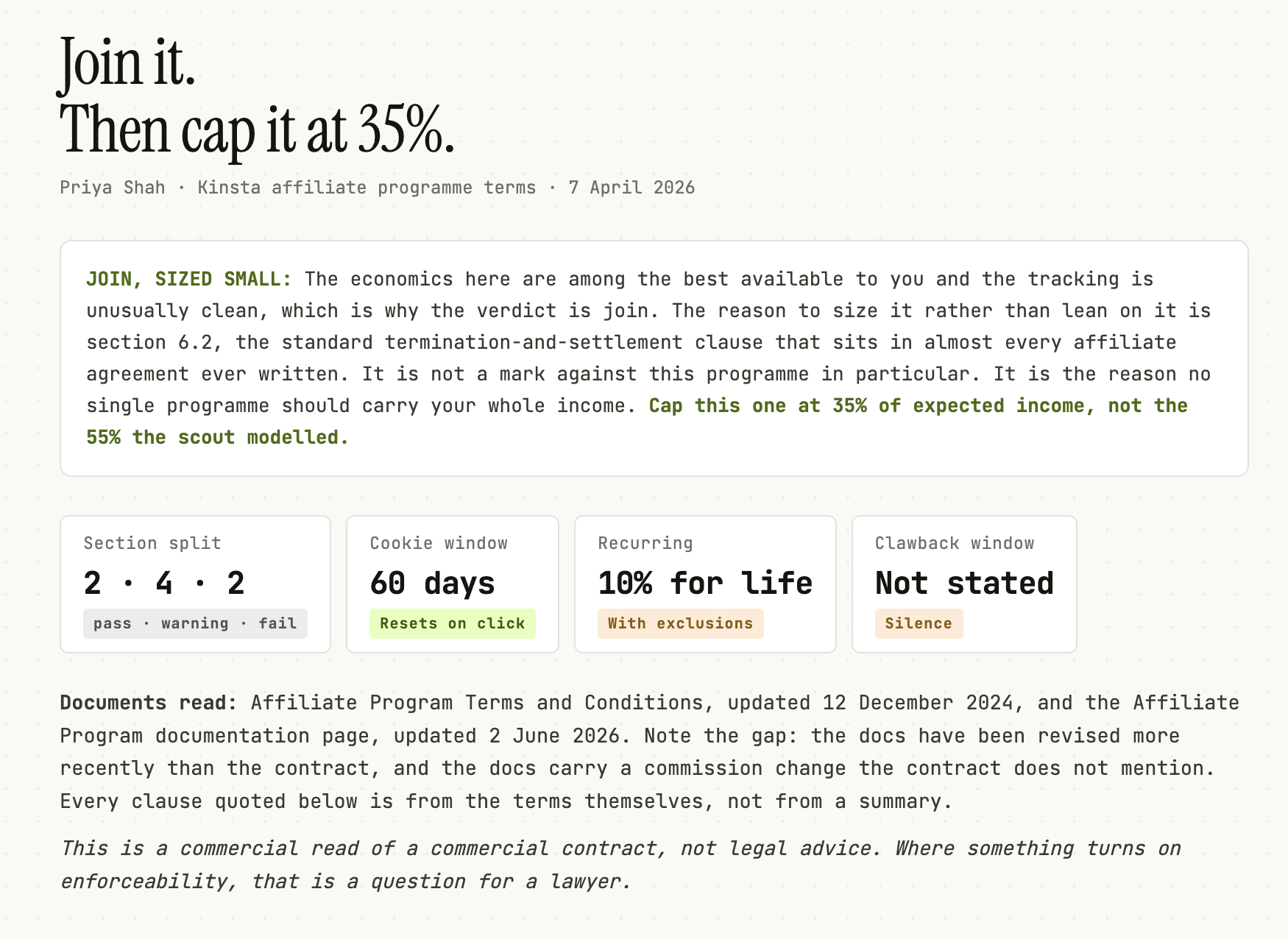
The clause that decided the sizing, section 6.2, is not unusual. It sits in almost every affiliate agreement ever written, which is exactly why no single programme should carry your whole income. Read the full grade (PDF) ↗
A report, saved to your own folder.
A verdict in the first line: JOIN, JOIN SIZED SMALL, or DO NOT BUILD ON THIS. Eight sections scored PASS, WARNING or FAIL, with the clause quoted. Where the terms are silent, it says so, because silence in a contract is a finding and it rarely resolves in your favour.
Then six to ten questions to put to the program manager, written so you can paste them into an email. A program manager who will not answer them in writing has answered them.
Then the strongest argument against its own verdict, because a tool that only agrees with itself is not worth running.
The eight sections tell you whether one program pays fairly. The report ends on the bigger one: is what your audience buys earnable on at all?
A 25% recurring commission on a subscription somebody keeps two years is worth roughly a hundred times a 4% one-off on a physical product. Same work to produce the conversion. If your audience's spending is mostly one-off, low value, or bought on impulse, the grader says so plainly.
That is the sentence people spend a year not hearing.
Free. Install once, use on every program you ever consider.
It runs in your own Claude, on your own machine. No card. Nothing is sent, posted, or shared, and it never logs into anything.
free · 1 worker · runs in your Claude · no card
Redundant publishes free AI workers and paid playbooks for people building income they own. The grader comes out of The Promote Playbook, and it stays free either way.